
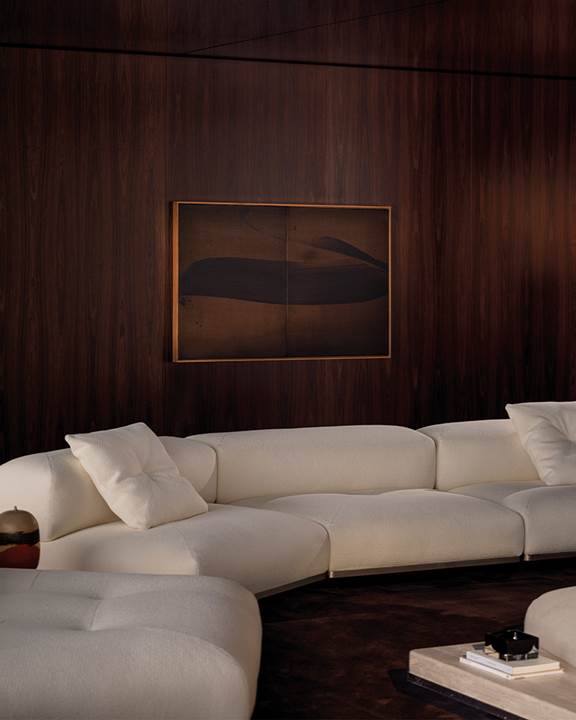
How a simple idea gave us greater freedom to shape the spaces we call home.
A sofa quietly influences how a room is used: where people gather, which direction they face, and how much space remains for movement. Change its arrangement, and the atmosphere can change with it. Modular seating gives this everyday observation a physical form, allowing individual elements to become part of different compositions.
The idea has a significant place in twentieth-century Italian design. In 1970, architect Mario Bellini introduced Camaleonda, a seating system organised around generous square modules. Its original design combined 90 × 90 cm seat units with a system of cables, hooks and rings. Seats, backrests and armrests could be disconnected and recombined, allowing the arrangement to evolve with the needs of its owner. Here was a piece of furniture whose composition remained open to revision.
This interest in adaptable spaces belonged to a wider conversation. In 1972, New York’s Museum of Modern Art presented Italy: The New Domestic Landscape, curated by Emilio Ambasz. The exhibition brought together 180 household objects and 11 environments commissioned by the museum. Its original press release described designers exploring changing lifestyles, more informal family relationships and evolving ideas of privacy. Furniture was being considered through its relationship with daily life and the space around it.
Among the designs represented was Cini Boeri’s Serpentone, created in 1971. This long polyurethane seat could bend into inward or outward curves to suit its setting. Alongside the possibilities of separate modules, it offered another approach to adaptable seating: a continuous line that could take different shapes. These experiments suggest a shared ambition to give people more influence over their surroundings.
For a home today, these ideas offer a useful starting point. Begin with the activities a room needs to accommodate. Where will people sit to talk? Which routes should remain open? Does the furniture make the most of the view, the daylight or a favourite corner? The answers help determine the composition, giving each element a purpose within the room.
When considering a modular sofa, look closely at how its components connect and which arrangements the design actually supports. Seat depth, back support and the proportions of each unit deserve the same attention as the overall silhouette. The most useful flexibility is the kind that works comfortably within your own space.
A home acquires its character through use: familiar places to sit, conversations that continue into the evening, small changes made over time. Furniture that allows for those changes gives its owner an ongoing role in the design of the room. The composition can remain personal, considered and open to whatever comes next.

 No products in the cart.